Key Insight
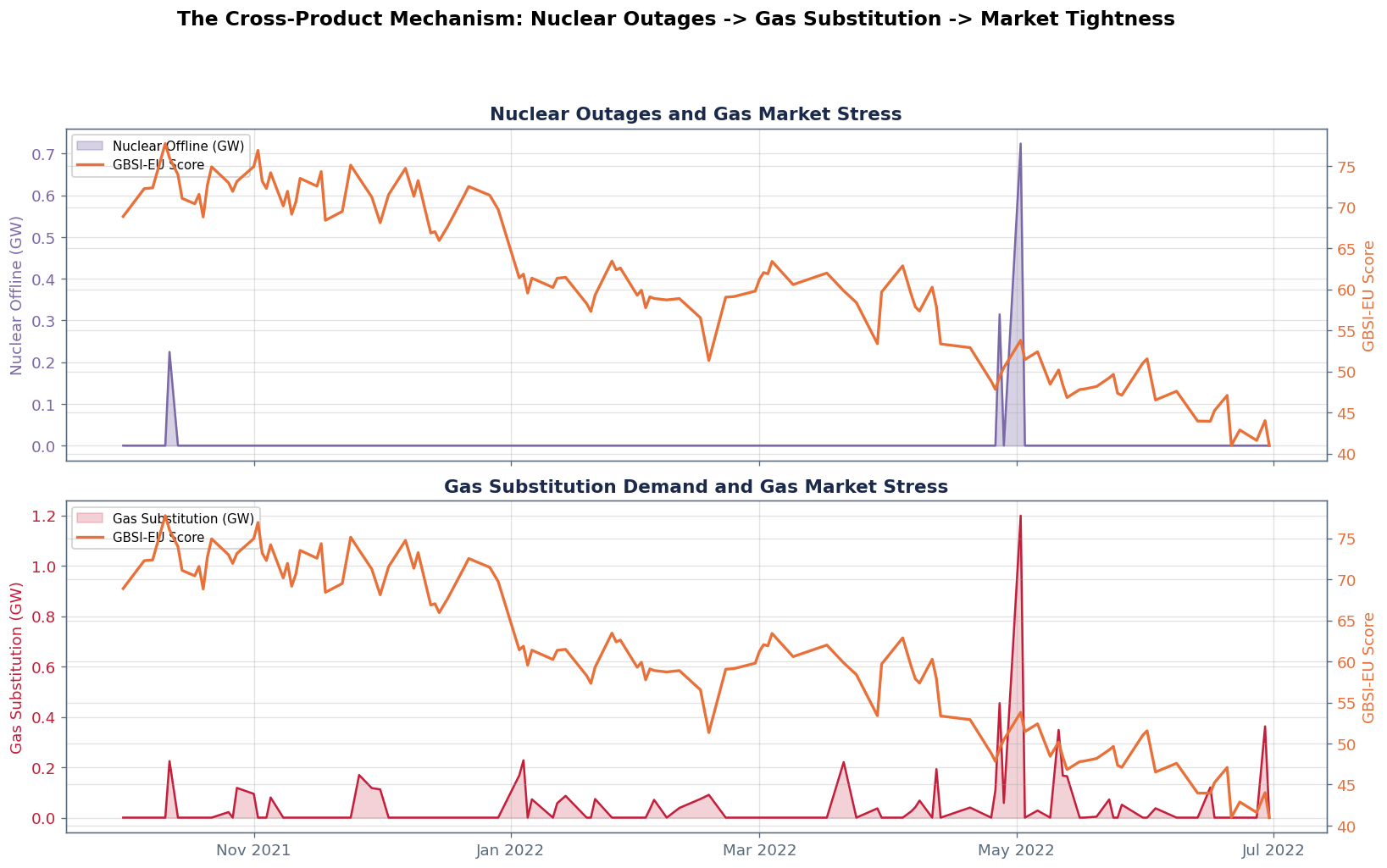
When France took around 50% of its nuclear fleet offline during a cold spell, PEMI's weather-amplified event layer captured the compound risk that single-variable monitoring systems missed. Gas-for-power substitution surged into an already stressed European grid.
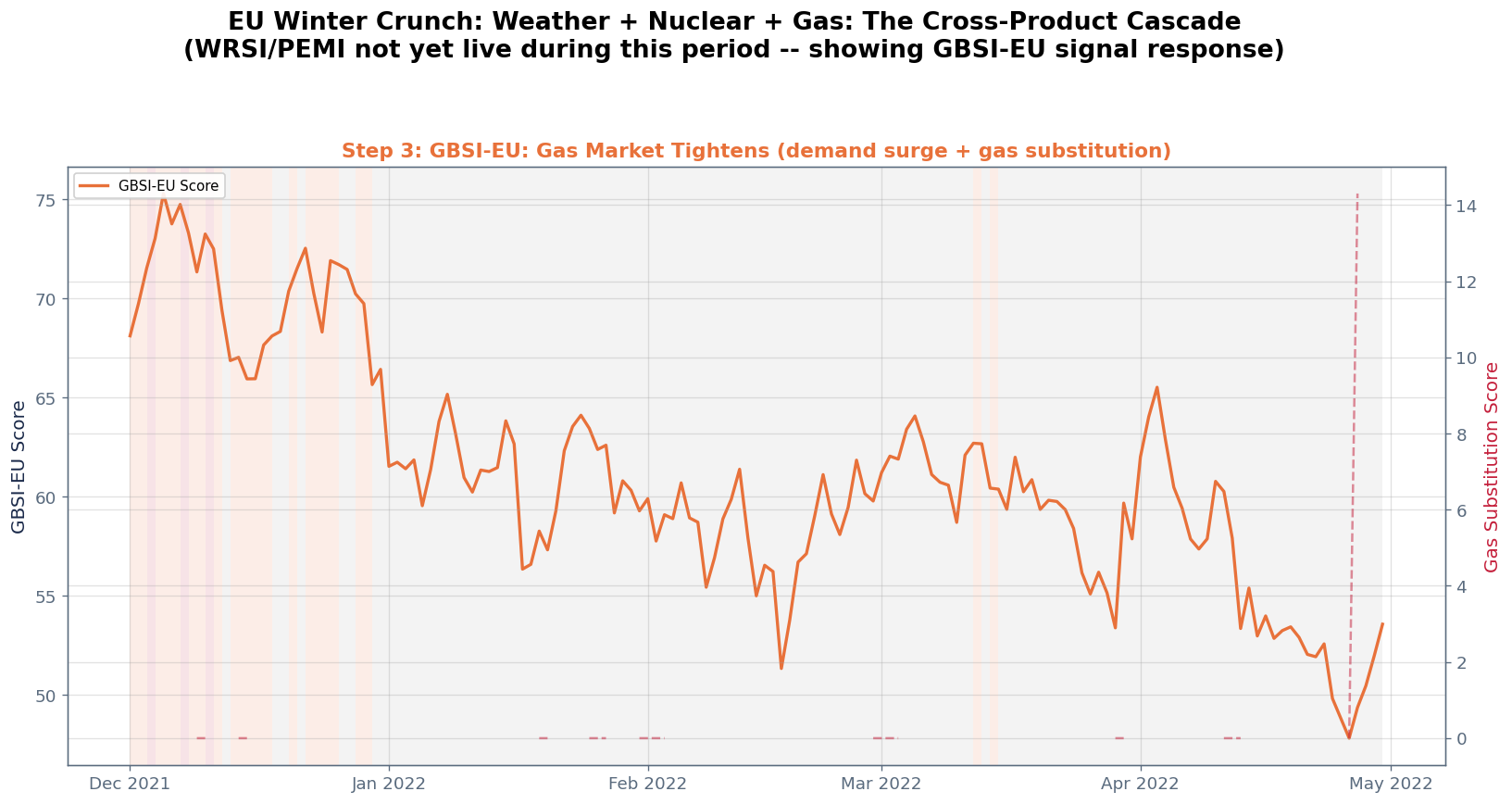
How weather uncertainty (WRSI), nuclear outages (PEMI), and gas market stress (GBSI-EU) interacted during the European winter crunch. WRSI and PEMI were not yet live during this period, so this chart focuses on the GBSI-EU signal response.

PEMI includes a weather amplification mechanism that links grid risk to weather uncertainty. When WRSI enters elevated regimes, PEMI's risk score is automatically amplified.
Key finding: In the 2021-22 French nuclear crisis, the amplification gate did NOT activate. This is analytically significant. Nuclear outages were so severe, with roughly half of the fleet offline, that gas-for-power substitution surged even without extreme weather. Nuclear alone was enough to tighten gas markets.
The weather amplification gate is the second line of defense: when a moderate nuclear issue coincides with extreme cold, the multiplier turns a manageable situation into a crisis. Winter 2021-22 didn't need the gate because the nuclear situation was already critical on its own.
| WRSI Regime | Multiplier | Winter 2021-22 Status |
|---|---|---|
| Stable | 1.0x | Most days |
| Volatile | 1.2x | Occasional |
| Transition | 1.5x | Not sustained |
| Extreme | 2.0x | Not reached |
The implication: The next crisis where nuclear outages are moderate but cold is extreme. That is when the amplification gate fires and the compound risk exceeds what either factor alone would produce.
When nuclear goes offline, gas-fired generation fills the gap. This drives gas demand higher, which GBSI-EU captures through its gas_substitution_score pillar.
The charts below show how nuclear outages drove gas substitution demand, which GBSI-EU captured through its gas balance pillars. This reflects the structural link between PEMI and GBSI-EU. As nuclear availability declines, gas-fired generation fills the gap, tightening European gas balances.

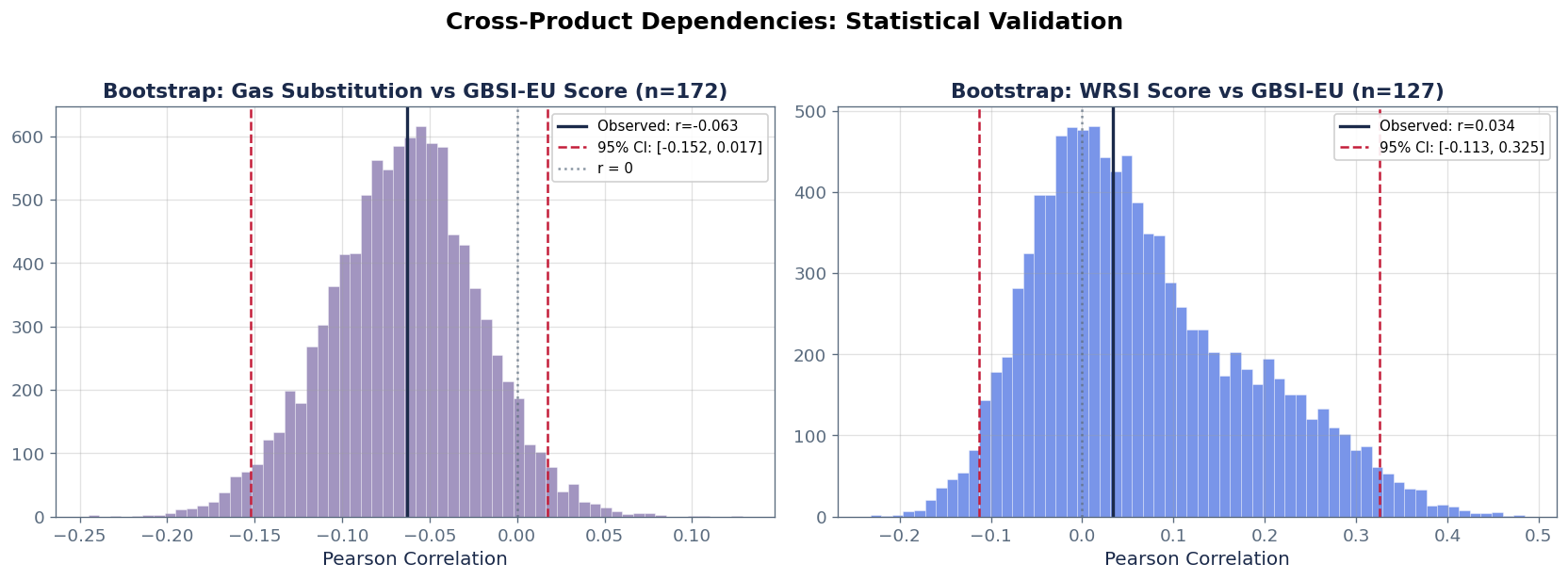
The scatter plot showed the nuclear-to-gas substitution mechanism visually. Here we test the daily correlation rigorously with bootstrap 95% CIs. Note: because gas_substitution_score is one pillar within a multi-pillar composite (GBSI-EU), a weak daily correlation is expected. Other pillars (storage, flows, demand) can offset gas substitution on any given day. The structural dependency exists within the modelling pipeline rather than in day-to-day price co-movement.
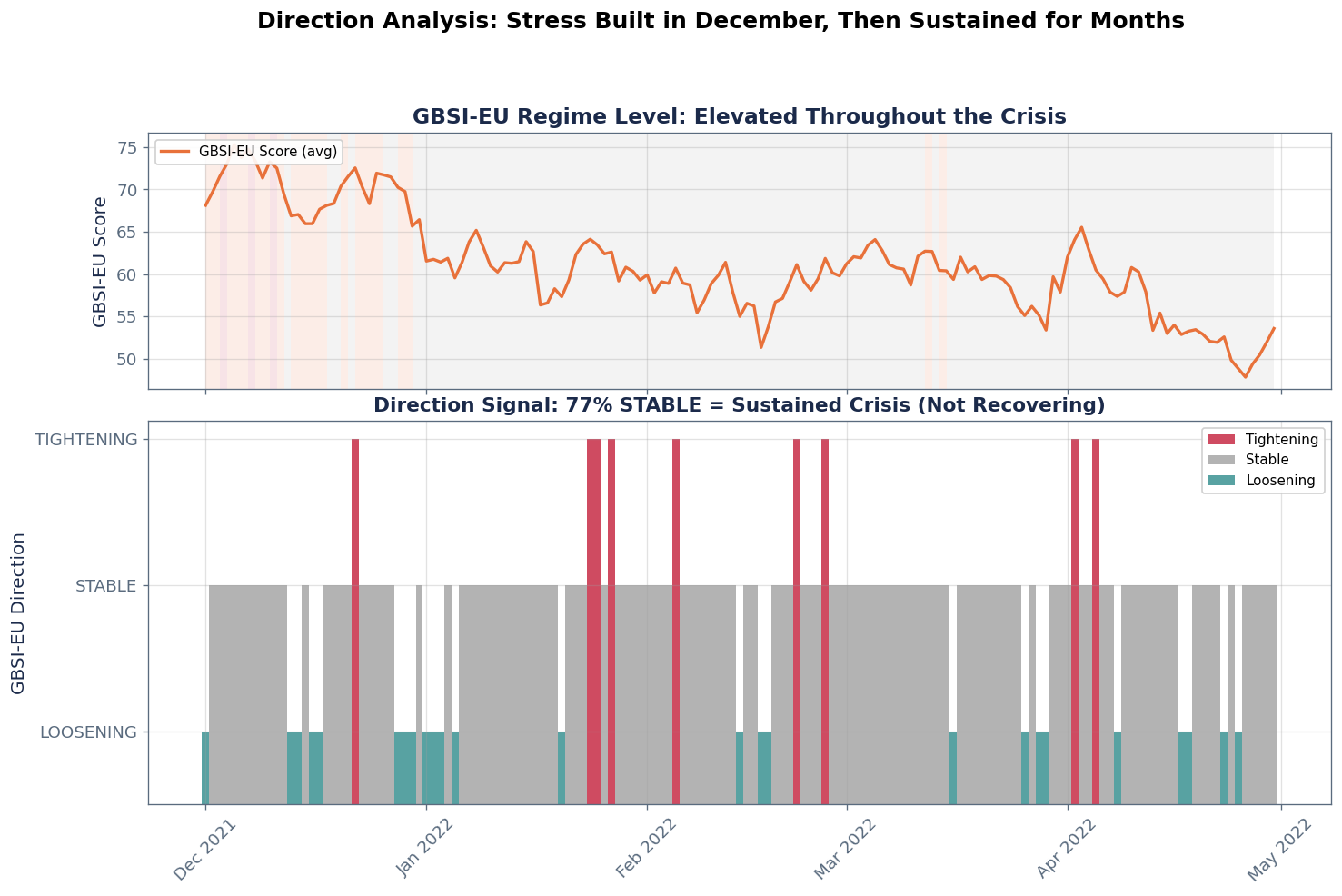
The direction signal (TIGHTENING, STABLE, or LOOSENING) tells us whether fundamentals were actively deteriorating, sustained at current levels, or improving.
For the EU winter crunch, the direction data reveals a critical institutional insight: A STABLE signal at an elevated baseline is the signature of a sustained crisis. The initial TIGHTENING phase (stress building) gives way to STABLE (stress plateaued at high levels), meaning the market reached peak stress and stayed there for months. This is distinct from a brief spike that quickly loosens. The direction signal tells you when stress is persistent, which matters more for position sizing than the regime label alone.
The pattern: TIGHTENING in early December (the ramp-up), then STABLE through April (sustained elevated stress), with occasional LOOSENING that never persisted.


| Cross-Product Link | Correlation (r) | 95% CI | N | Statistically Significant | Mechanism | Significant |
|---|---|---|---|---|---|---|
| Gas Substitution Score -> GBSI-EU | -0.063 | [-0.152, 0.017] | 172 | No | Nuclear outages -> gas-for-power demand | nan |
| WRSI Score -> GBSI-EU | 0.034 | [-0.113, 0.325] | 127 | No | Weather-driven demand | nan |
| WRSI -> PEMI Amplification Gate | N/A (coded) | N/A | N/A | nan | Weather amplifies grid risk (2nd line of defense) | 0/5000 activations |
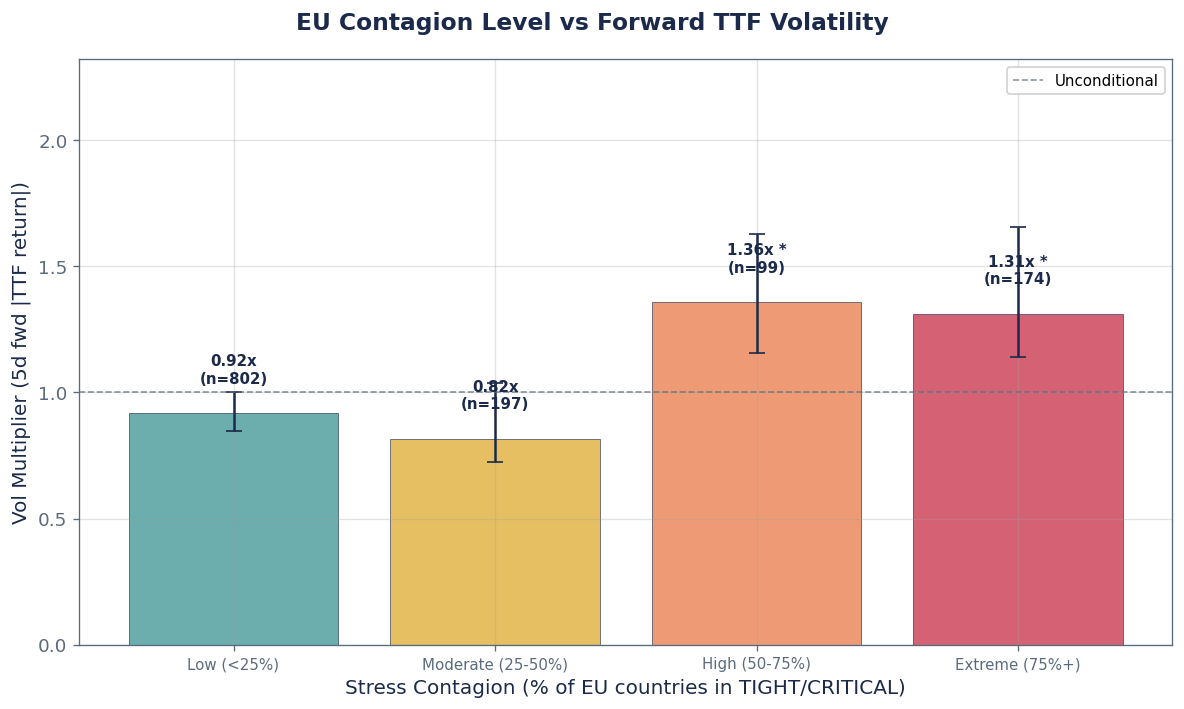
Individual GBSI-EU regime and direction labels do not achieve statistical significance for predicting TTF forward volatility. But EU-specific contagion . the percentage of EU countries simultaneously in TIGHT or CRITICAL, does. It is the only predictor where bootstrap 95% CIs exclude 1.0x.
This reflects market structure. When stress is localised, neighbouring countries absorb the shock through pipeline rerouting or LNG reallocation. When more than half of Europe is simultaneously stressed, the system saturates and forward volatility rises sharply.

The EU winter crunch was not a single event. It was a cascade that played out across three Snowtrail products in sequence:
| Timeline | Signal | What It Told You |
|---|---|---|
| Week 1-2 | WRSI enters TRANSITION | Cold forecast uncertainty rising. Demand risk building but not yet confirmed |
| Week 2-3 | PEMI nuclear_offline rises >30% | French nuclear fleet going offline. Gas-for-power substitution demand increasing |
| Week 3-4 | GBSI-EU direction shifts to TIGHTENING | Gas balance confirming compound stress. Cold demand plus nuclear substitution hitting storage |
| Weeks 4-20 | GBSI-EU direction 77% STABLE at elevated levels | Crisis plateaued at high stress. No relief in sight, sustained procurement costs |
| Throughout | EU contagion >50% of countries TIGHT/CRITICAL | The only statistically significant predictor of TTF vol (bootstrap CIs exclude 1.0x) |
Each product in the cascade gave traders 1-2 weeks of lead time over the next. A desk watching only TTF prices would have seen the move; a desk watching Snowtrail signals would have understood why it was happening and how long it would last.
The three-product cascade (WRSI, PEMI, GBSI-EU) historically corresponds to compound gas market stress that persists for weeks rather than days.
When WRSI enters TRANSITION while PEMI nuclear offline rises above 30%, the signal combination typically precedes:
The direction signal is the key risk management input. A STABLE signal at an elevated baseline historically indicates persistent stress rather than a transient spike, with implications for position holding periods and hedge ratio adjustments.
The EU winter crunch was driven by the interaction of three forces that Snowtrail tracks through three interconnected products:
A STABLE signal at an elevated baseline is the signature of a sustained crisis. The initial TIGHTENING in December 2021 (stress building) gave way to months of STABLE direction (stress plateaued at crisis levels). Occasional LOOSENING never persisted. For position sizing, this is the difference between a day trade and a multi-month position.
EU Power/Gas Trading Desk: - WRSI TRANSITION + PEMI nuclear offline rising = compound risk building. Long TTF, long power forwards. The cascade gives you one to two weeks of lead time - GBSI-EU direction = STABLE at elevated levels: do not expect relief. Maintain long positions. The crisis is not getting worse but it is not going away - GBSI-EU direction = LOOSENING that does not persist: false relief. Do not cover longs on a single week of LOOSENING. Wait for consecutive weeks - PEMI weather amplification gate active = the 2.0x multiplier fires. This is the highest-conviction trade signal: nuclear moderate + cold extreme = compound crisis
Utility with Gas + Power Exposure: - WRSI TRANSITION = cold forecast with high uncertainty. Pre-position gas procurement and power hedges before the cascade reaches GBSI-EU - PEMI nuclear_offline > 30% = gas-for-power substitution demand rising. Your gas supply costs will increase even without a cold snap - STABLE direction at TIGHT/CRITICAL = sustained elevated procurement costs. Renegotiate supply contracts, activate flexibility clauses
Risk Manager: - The three-product cascade is a stress-test template: when WRSI + PEMI + GBSI-EU align, standard VaR underestimates. Apply compound stress scenarios - Direction persistence (77% STABLE for 5 months) = time-weighted risk is much larger than point-in-time VaR suggests. Adjust holding period assumptions - Contagion level is the statistically significant risk metric for TTF: when 50%+ of EU countries are simultaneously stressed, forward TTF vol rises above unconditional. Use contagion as the regime-conditional VaR input for EU gas - The gas substitution score is a leading indicator of cross-commodity correlation. When it rises, gas-power correlation increases. Hedge accordingly
Weather risk alone didn't explain the TTF move. Nuclear outages alone didn't explain it either. It was the compound effect, and the direction signal showed the worst part: once stress reached crisis levels, it stayed there for months. STABLE at a high baseline means "do not expect relief."
Request a demo to explore cross-product EU power and gas signals with your own use cases.
Request Demo